
He Was Going to Serve: Remembering Dmytro Panychuk
6.23.2026
He Was Going to Serve: Remembering Dmytro Panychuk
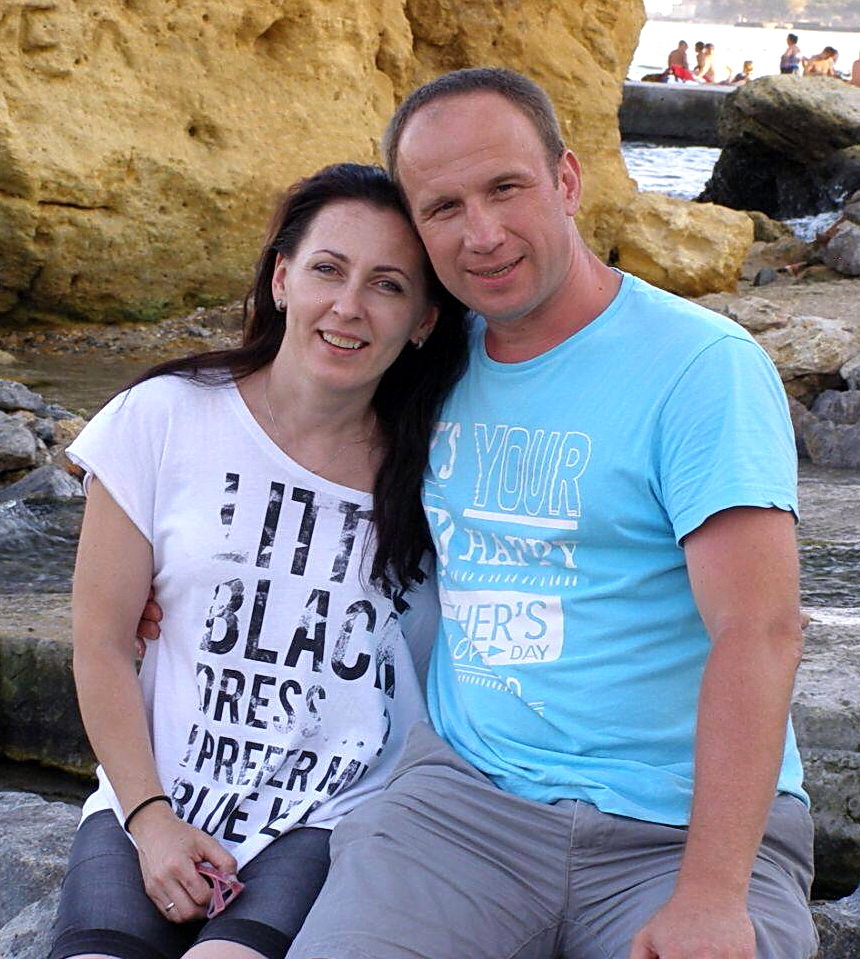
Dmytro Panychuk was a husband, father, and a servant in his church who knew how to feed people—both with food and steady words of faith. When war came to Vorzel, Ukraine, he turned his kitchen into a ministry of survival, sheltering 35 people. On March 3, 2022, Dmytro was killed by Russian forces while carrying food to neighbors hiding in a basement. His final earthly act was a testament to his life's mission: he wasn’t going to his death, he was going to serve.
"For I was hungry and you gave me food, I was thirsty and you gave me drink, I was a stranger and you welcomed me." — Matthew 25:35
Dmytro Panychuk was killed on March 3, 2022, in Vorzel, Kyiv region. He was 47. Russian soldiers shot him on the street while he was carrying food to people hiding in a basement from shelling and occupation. He died about 200 meters from his own home.
That sentence can hold the fact of his death. It cannot hold his life. Dmytro was a husband, a father of three, a cook by profession, and a servant in his church. He knew how to feed people — not only with bread but with care, attention, and steady words of faith. In peacetime, this looked like youth ministry and family retreats. In the first days of Russia's full-scale invasion, it looked like a basement in Vorzel where as many as 35 frightened people came to find safety, warmth, and food.
Faith, Family, and Ministry
Dmytro was born on November 8, 1974, in the village of Dovzhok in the Vinnytsia region. He trained as a cook — a profession that, in his hands, became a way of serving people. His coming to God was not formal. His wife Lesia remembers that when they first met, he had just found the Lord and was full of desire to help others. His faith was not only words; it immediately became action. His first ministry was with teenagers — almost pastoral care, Lesia says: attention, mentoring, the patient building of trust.
Lesia and Dmytro met at work. She came for practical training to the place where he was already a young chef, and he taught her what he knew. That is how their friendship began. They were married on September 9, 2000, in a Baptist church. From the very beginning, ministry was part of their shared life. They had three children: their son Danyil, born in 2002; their daughter Marharyta, born in 2005; and their son Damyr, born in 2009. The children do not really want to speak about their father today. The pain is still too deep. They say only that they miss him very much.
The family lived in Vorzel but served in Kyiv, in God's Glory Church — a daughter congregation of Salvation Church. Dmytro was part of the pastoral team; if the pastor was absent, he could take the service. Teenagers and families were the heart of his ministry. He was the center of any group — not because he tried to be but because it was warm near him. He did not divide life into "spiritual" and "practical." Serving God included all of it: prayer, the Word, food, shelter, advice, simple presence.
When the War Came
On February 24, 2022, war came to Vorzel from the first hours. Hostomel was nearby — a key target of Russia's plan to seize Kyiv quickly. Russian helicopters attacked the Antonov airfield and tried to land troops. For the people of Vorzel, this was not distant news.
Lesia remembers the morning as confusion and shock: "In the morning we were getting ready for work, and the person I worked for called me and said, 'Lesia, get ready and leave somewhere, the war has started.' And I thought: what war? What is this?"
Dmytro and Lesia prayed and came to a settled conviction together: God was leading them to stay. They began preparing the basement — water, food, space for people. Very quickly it became a place of rescue. Lesia began to cook. The kitchen was no longer a profession; it was a ministry of survival. As she puts it: "People asked, 'Are you not afraid?' We said that we are Christians. Maybe it is scary, but we know that there is God, there is hope, there is protection."
Word passed from one person to another. In the end, as many as 35 people sheltered with them.
Russia's plan to use Hostomel airfield as a bridgehead for Kyiv had been blocked by Ukrainian defenders, but Russian forces kept pushing in from the north. Fighting moved through Hostomel, Bucha, and Irpin — names that would soon be known to the world for what Russian troops did to civilians there. By early March, Vorzel was in direct danger. Dmytro tried to join the Territorial Defense, but he was told he was already doing the work that mattered most. In those first days, this, too, was a kind of defense–the defense of humanity.
The Day He Was Killed
On March 3, 2022, Dmytro went out to take food to the people in the basement. Lesia had cooked; he was bringing it over. It was a simple decision in extraordinary circumstances: people needed food, so he had to go.
He did not return.
From the upper floor of their home, Lesia saw a column of military vehicles moving through the streets — tanks one after another, soldiers walking beside them, the letters Z and V on the armor. Then she saw the soldiers firing through the streets. Not at military positions. Not at specific targets. Down the streets, at whoever might be there.
A woman called. Her own daughter's parents — friends of the family — had just been shot. "Who killed them?" Lesia asked. "It cannot be! These are our people!" The woman told her: no, they are Russians, and they do not care whom they kill.
For three days Lesia prayed that her husband would come back. After three days, an elderly man came to the people in the shelter and said there was a man's body lying on the street. It was Dmytro. His documents were with him. He died about 200 meters from home, at the very moment he was carrying food to people in the basement, as Russian soldiers moving through Vorzel fired on anyone they saw.
His ministry became the last earthly act of his life.
A Pain That Cannot Be Explained
When Lesia learned that her husband had been killed, her first response was not strong faith or correct theology. It was an abyss of pain.
"In the first moments I said: Lord, You could not allow this. You could not. I need him so much. I will not be able to raise three children by myself. I will not be able to. You know that he is strong, he is spiritually strong. I could follow him. But how? You could not allow this."
In despair, thoughts came: Then take me, too. I do not want to live, because I will not be able to.
But in that basement — in occupied Vorzel, in the middle of war and death — God sent people who stayed close. Two other believers prayed with Lesia and the children and did not allow her to remain alone with that despair.
When she told the children that their father had died, they responded in a way she did not expect. They told her that dad lived with the Lord; he was well now; it was hard for them here. They told her she had to live. That she was the one who had to keep telling them about life with God. Their words did not remove the pain. They helped her take the next breath.
Later, still in occupied Vorzel, Lesia received what she remembers not as an answer but as a silence: "I could not understand: was 47 years really the time for Dmytro to die? God, this cannot be! It is too early. But somehow, one day, God gave me silence in my heart. Yes, exactly there! There, in the basement, in occupied Vorzel, where people were being killed on the streets, God gave me silence. God gave me confidence that He continues to control our life, continues to be with us even in times when someone goes against His will and brings grief to others."
Eventually the family was able to leave Vorzel. Dmytro was buried in Bilohorodka, near his grandfather. The true memory of him is not contained in a grave.
What This Death Belongs To
Dmytro was killed in the opening days of a Russian operation the world has since learned to name by the towns where it failed: Hostomel, Bucha, Irpin. The same offensive that took his life produced the killings later documented in Bucha — including the deaths of Orthodox priests Maksym Kozachyna and Oleksandr Kysliuk, evangelical seminary dean Vitaliy Vynohradov, and Ihor Horodetskyi, an evangelical minister whose body was found in a mass grave.
Mission Eurasia's Religious Freedom Initiative has documented these losses since 2014. The February 2025 report Faith Under Russian Terror records at least 47 Ukrainian religious leaders killed as a direct result of Russian aggression, alongside more than 650 religious sites destroyed, damaged, or looted. Dmytro's name will not appear on the formal list of clergy killed — he was a layman and a pastoral team member, not an ordained minister. But his death belongs to the same documented pattern: Christians killed by Russian forces while serving the wounded, the displaced, and the hungry in their own communities.
The Religious Freedom Initiative exists to keep these stories from disappearing — to document, to advocate, and to support the believers who continue to serve where serving costs everything.
Dmytro was not a public hero in the usual sense. He did not command an army or hold a high position. At the critical moment, he did what he had always done. He cooked food. He carried it to people. He did not leave those who were afraid. He was not going to his death. He was going to serve. And through this, his life still speaks.
Honor a Legacy of Service
In the darkest days of the invasion, Dmytro Panychuk turned his kitchen into a sanctuary—sheltering 35 people and choosing to serve rather than flee. Today, you can carry that same light to families still trapped in the shadow of war. Your gift to the Religious Freedom Initiative protects the stories of faithful believers and delivers life-saving food, shelter, and hope to communities under crisis.