
The Pastor Who Stayed Close: Remembering Leonid Skumatov
6.01.2026
The Pastor Who Stayed Close: Remembering Leonid Skumatov
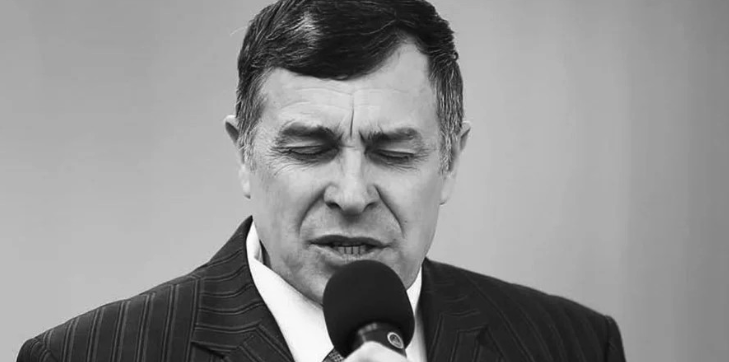
Pastor Leonid Skumatov stayed in the frontline city of Myrnohrad to serve the elderly and wounded. He was killed by a Russian drone on September 20, 2025.
"He is not the God of the dead, but of the living, for all live to Him." — Luke 20:38
By September 2025, Myrnohrad was living in the shadow of the front line. The mining city had been steadily losing the markers of ordinary life. Homes were damaged, pharmacies and shops no longer functioned as they once had, communication was failing, and the roads grew more dangerous with each passing week. The people who remained were mostly those who could not leave — the elderly, the sick, the wounded, and those without the strength, resources, or relatives to carry them out.
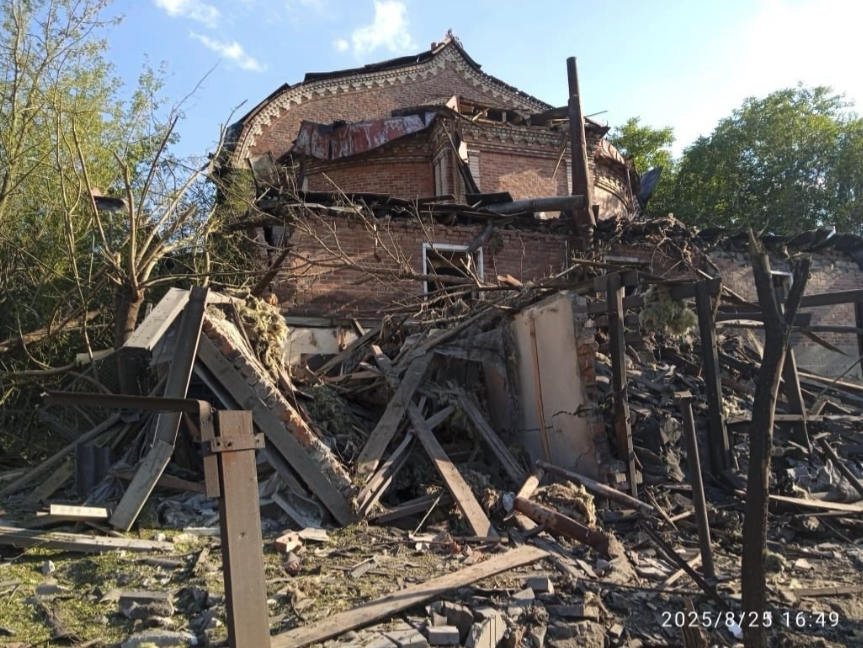
Among them was Leonid Stepanovych Skumatov, pastor of the Evangelical Christian Baptist church in Myrnohrad. He could have left. People urged him to. His family wanted him safe. But his answer was always the same: "It is not time yet. God has not yet told me to leave everything and go. There are still people here who need to be served."
Those words turned out to be the summary of his whole life.
A Faith Formed at Home
Leonid was born on October 9, 1955, into a Christian family of twelve children. His path to God did not come through a sudden emotional turn but through the long, patient work of family witness — the example of his parents, the quiet shaping of conscience around the kitchen table, the convictions that took root before he was old enough to articulate them. Before his military service, he was baptized in water in what was then Krasnyi Luch, by Presbyter Poveshchenko.
He returned again and again throughout his life to a simple conviction: faith must be visible in character, in faithfulness, in service to people, in the ability to place another person's needs above one's own. What he had seen in his parents became the way he lived.
After his military service, Leonid met Liuba, a young Christian woman who lived and worked in Myrnohrad. They married in 1986 and settled in the mining city, which became the place of his calling. At 31, he was ordained a deacon, and at 33 a presbyter — ordained by Anatolii Honcharov and Ivan Kryhin. From that point on, his life was inseparable from the Myrnohrad congregation. He helped build the church building with his own hands. He worked in the mine by day and gave his evenings to ministry: leading worship, visiting members, studying, praying. He completed theological training at a seminary in Makiivka. People remember him as quiet, peaceful, not quarrelsome — a peacemaker who did not build ministry around his own name.
The First Church Was His Family
For Leonid, pastoral ministry did not begin at a pulpit. It began at home. His daughter Daria remembers that every evening her father gathered the family for devotions — reading Scripture, listening to reflections, singing, praying. The children grew up in an atmosphere of faith, love, and care that was not performed but lived.
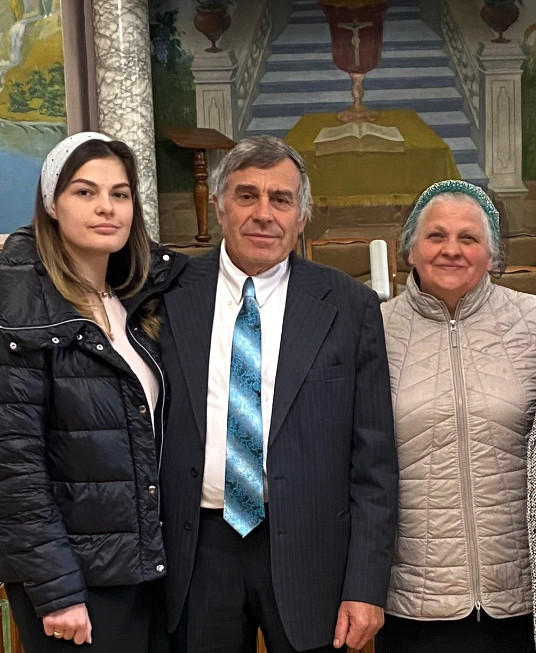
The parents involved their children in practical ministry as well, visiting elderly believers and those in need. Leonid would say, "So that not one sheep would fall away from the faith." For him, the people of the church were not statistics or names on a list. They were sheep for whom a shepherd bears responsibility before God. If someone grew weak, became ill, or could no longer attend, that person did not disappear from view — they needed more attention, not less.
The Lord gave Leonid and Liuba five children: Serhii, Andrii, Pavlo, Tymofii, and Daria. All were baptized, started their own families, and serve God in their own ways today.
When the War Came
As the war closed in on Myrnohrad, Leonid's first concern was the safety of his family. He made sure his wife, children, and relatives left. But he himself stayed — not out of stubbornness or denial. He saw the danger clearly. He saw the elderly, the sick, the lonely, those without transport or money or relatives who could carry them out. He saw people who, before the war, may never have shared his faith — who may even have mocked evangelical Christians. In the decisive sense, this did not matter to him. Christ served people. Therefore, a pastor must serve people.
What war exposes in a man, it exposed in him: faithfulness, mercy, sacrifice, prayer, and the capacity to serve not only those who were convenient but everyone in need.
The church did not stop living. By 2025, about 30 people still gathered for worship in the Myrnohrad congregation, joined by believers from other churches and by people who had never attended before. Roughly 2,000 civilians remained in the city, and many were seeking comfort — in God, in fellowship, in simple human support. Word about the church and its pastor spread among those who stayed.
The congregation organized a prayer marathon — round-the-clock intercession. For Leonid, prayer was not an addition to ministry; it was his breath. Liuba remembers that every evening from five o'clock until seven the next morning, every two hours he set aside half an hour for Scripture and half an hour for prayer. He prayed for peace, for people to come to faith, for neighbors, for his family, for his children and grandchildren. He brought every need that reached him before God.
About 27 people came to repentance during this period, and 14 were being prepared for baptism — a remarkable testimony of God's grace in a city where death was near.
Pastoral Ministry on Foot
Leonid did more than lead worship. He went constantly to people — acquaintances, neighbors, the elderly, the sick, those who could not come to church. He read Scripture with them, prayed, held home services, and brought food, water, and medicine.
When deliveries to Myrnohrad's shops and pharmacies all but stopped, he traveled to Pavlohrad every month or two to buy supplies, crossing a dangerous road. He covered part of the cost himself; the rest came from donations. He was warned that Russian forces hunted volunteers the way they hunted soldiers — that any vehicle, any bag, any movement could become a drone's target. He went anyway. If he did not go, someone would be left without medicine. If he did not visit a lonely person, that person might die in silence and fear.
One episode captures it. A woman's son had stepped on a mine and severely injured his leg. Infection had set in; the son could not walk, and the mother could neither lead nor carry him. The man was dying. Leonid placed him on a wheelbarrow and, over the course of many hours, pushed him on foot roughly 20 kilometers to a place from which he could be taken farther. The wounded man survived.
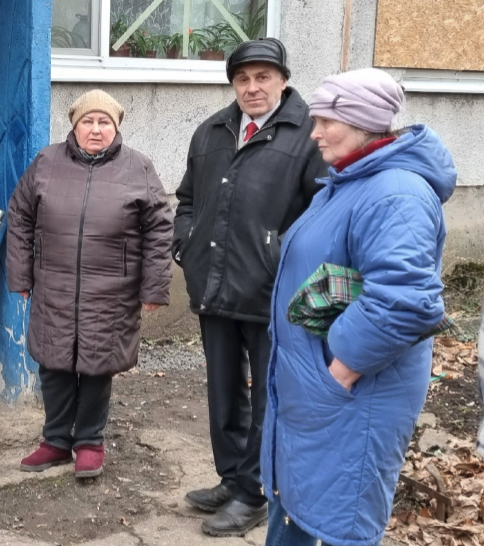
The volunteer Andrii Malov remembered traveling with Leonid several times to Ocheretyne to visit people living in basements. What surprised Andrii was that Leonid traveled to the frontline town under constant shelling in a suit and a red tie. For him, this was not a humanitarian "action" or an extreme adventure. It was his mission, and he dressed for it.
The Last Day
On September 19, 2025, Leonid went to bring food to an elderly man. During this period, Russian forces were using loitering drones extensively — weapons whose operators can clearly see their targets but, in Myrnohrad, did not distinguish between soldiers and civilians. Leonid was in civilian clothes, carrying out an obvious humanitarian errand.
He suffered severe wounds, especially to his face. After the strike he was still alive. There was no ambulance to call — the frontline city was no longer served the way rear areas were. A resident named Serhii did what he could. Leonid told him his name, where he was from, handed him his phone, and asked him to call his family. Even then, his thoughts were with them.
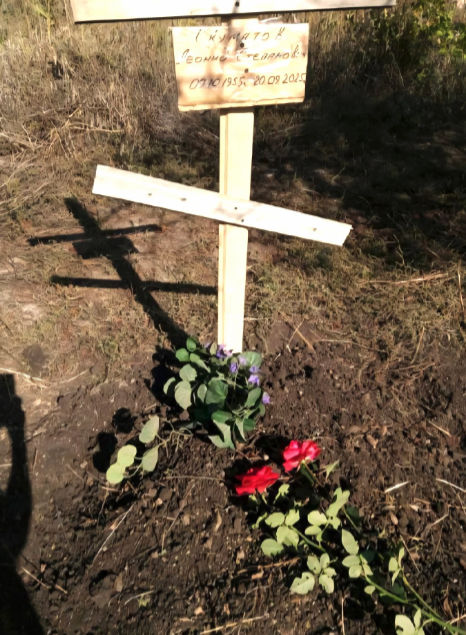
His wounds were beyond what could be treated. The next morning, on September 20, 2025, his heart stopped. Burial at the cemetery was impossible — there was no access. He was buried in a yard. His relatives were sent a photograph.
He died a few weeks before his seventieth birthday.
In his final days, Leonid left a brief message that his family later shared. There is no fear or despair in it — only gratitude, calm readiness, and the summary of a life. "Everything I had — my strength and my heart — I sought to give to the service of God and people."
A Pattern, Not an Isolated Tragedy
Leonid Skumatov's death is not an isolated event. It belongs to a documented pattern. Mission Eurasia's Religious Freedom Initiative has tracked the systematic targeting of Ukrainian church leaders since Russia's 2014 incursion and through the full-scale invasion that began in 2022. According to the Initiative's February 2025 report, Faith Under Russian Terror, at least 47 Ukrainian religious leaders had been killed as a direct result of Russian aggression by the end of 2024 — among them Baptist pastors, Orthodox priests, Pentecostal ministers, and Adventist clergy. Hundreds more have been detained, tortured, deported, or driven from their homes. More than 650 religious buildings have been destroyed, damaged, or looted.
Pastors like Leonid are why those numbers matter. The statistics name a reality that, on the ground, looks like a wheelbarrow pushed 20 kilometers down a mined road. It looks like an elderly man receiving a bag of food in a city the world has half-forgotten. It looks like a suit and a red tie in a basement.
The Religious Freedom Initiative exists to document these losses, to advocate for those still imprisoned or persecuted, and to support the church leaders who continue to serve in places where serving costs everything. The work is necessary precisely because men like Leonid Skumatov refuse to leave — and because the world should not be allowed to forget what they did, or what was done to them.
He wanted to rest. He postponed it because he believed it was not yet time. There were still people. There was still a city that needed prayer.
Now he has entered his rest. But his story continues — in the family that carries his faith, in the congregation he loved, in the testimony of a pastor who stayed where it was frightening because people were still there.
Defend Faith Under Terror
Stand with the courageous leaders who refuse to leave. Your gift documents truth, advocates for the persecuted, and provides critical aid to pastors serving on the front lines of faith.